

Article: Diwali Table Setting Ideas with Luxury Dinnerware and Serveware
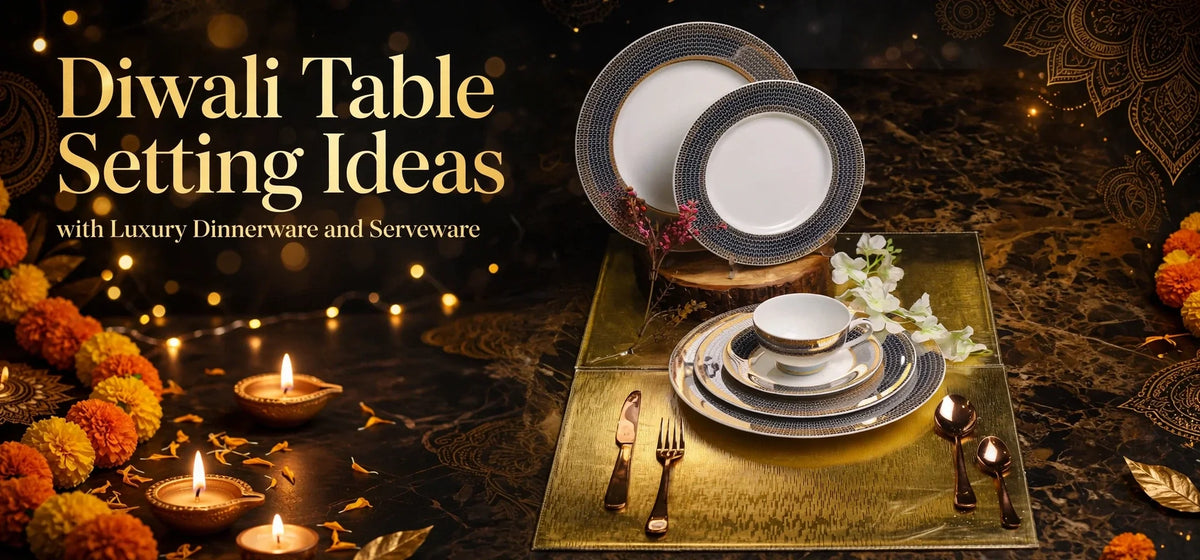
Diwali Table Setting Ideas with Luxury Dinnerware and Serveware
A beautiful Diwali table does not need to be overloaded with decorations. Start with an elegant dinner set, choose two or three festive colours, add warm lighting, use coordinated glassware and keep enough open space for food.
Gold-rimmed porcelain works beautifully for a traditional luxury look, while floral, blue, green or platinum-accented dinnerware can create a more contemporary festive table.
Most importantly, design your table around the way your family actually eats. A dining table should still feel comfortable once the curries, rotis, rice, starters, desserts and drinks arrive.
How Can You Create an Elegant Diwali Table Setting?
The easiest way to create an elegant Diwali table is to treat your dinnerware as the centre of the setting, instead of trying to decorate every empty corner.
Choose a statement dinner set first. Build your table around its colours and detailing, then add a table runner, napkins, glassware, candles or diyas and a few festive accents.
This approach makes the table look considered rather than crowded.
And that matters during Diwali because your table eventually needs to hold something much more important than decoration — food.
For Diwali 2026, which falls on 8 November, this kind of preparation can begin well before the festive week rather than becoming another last-minute job.
1. Start with Your Dinner Set, Not the Decorations
One of the easiest mistakes when planning a festive table is buying the decorations first.
-
You find a beautiful runner.
-
Then some gold candles.
-
Then colourful napkins.
-
Then flowers.
And when you finally place your dinner set, nothing quite belongs together.
Reverse the process.
Choose the dinner set you want to use for your Diwali meal first, and let everything else follow from it.
For example, if your dinnerware has gold detailing, you already have your metallic accent. You don't need gold everywhere else. A few warm touches will be enough.
If your plates feature blue, green or floral patterns, pick one shade from the design and repeat it subtly through napkins, flowers or a runner.
The result immediately feels more coordinated.
Azure Buying Insight: When buying dinnerware specifically for festive entertaining, don't choose it based only on how beautiful a single plate looks. Imagine the entire set on a dining table surrounded by Indian food, glasses and serving dishes.
2. Let Gold-Rimmed Dinnerware Bring the Festive Feel
Few finishes work as naturally with Indian festive dining as gold.
But there is a difference between using gold and making everything gold.
A porcelain dinner set with a fine gold border can provide enough festive detailing by itself. Pair it with a neutral or deep-coloured tablecloth, clear glassware and warm candlelight and the table already feels dressed for an occasion.
The Azure Collection currently carries several porcelain dinner sets with gold detailing, including Rasalas, Floeur, Valentino, Nira and Royal Calyx, alongside platinum-lined options such as Asuka.
This is particularly useful if you want dinnerware that can move beyond Diwali.
Use it with candles and festive accents in November.
Pair it with white linen for an anniversary dinner.
Use it with flowers for a family celebration.
Good festive dinnerware shouldn't spend eleven months inside a cupboard.
3. Choose a Simple Diwali Colour Palette
You don't need every traditional festive colour on one dining table.
In fact, limiting yourself to two main colours plus one metallic accent usually creates a much more luxurious result.
Try combinations such as:
Ivory + Deep Green + Gold
Elegant, rich and easy to style with greenery.
White + Burgundy + Gold
Warm and festive without becoming too bright.
Blue + White + Silver
A refreshing choice if you prefer contemporary table settings.
Cream + Maroon + Brass
Traditional and ideal for a warm Indian festive atmosphere.
White + Floral Dinnerware + Gold
Perfect when you want the crockery itself to provide most of the colour.
The trick is repetition.
If burgundy appears in your napkins, repeat it in a small floral detail. If gold appears on the rim of your dinnerware, echo it once through cutlery, diya holders or another subtle accent.
You don't need to repeat it everywhere.
4. Layer the Table Without Making It Look Busy
Luxury tables often look effortless because they are carefully layered.
Start with your base: either the natural dining table or a tablecloth.
Then add a runner if required.
Place the dinner plate.
Add the appropriate bowl or smaller plate.
Position glassware.
Finish with the napkin.
That's already enough structure for most homes.
A charger plate can add another layer for a formal Diwali dinner, but don't treat it as compulsory.
The goal isn't to reproduce a hotel banquet table.
It's to create a dining experience that feels special in your own home.
5. Don't Forget About Glassware
People spend considerable time choosing dinnerware and then place whatever everyday glass happens to be available next to it.
That can break an otherwise beautiful table.
Your glasses don't need heavy ornamentation. In many cases, simple, clear glassware works better beside decorative dinnerware because it gives the table visual breathing space.
If the plates are minimal, textured or statement glassware can take a stronger role.
The Azure Collection's current glassware selection includes tumblers, long drink glasses, beverage glasses and other premium glass formats, giving you options for both everyday and occasion-based tables.
Think about what guests will actually drink too.
Water should be easy to reach. If you're serving mocktails, juices or festive drinks, choose glassware suitable for those separately instead of overcrowding every place setting with unused glasses.
6. Make Space for Indian Food
This is one of the most important Diwali table setting ideas for Indian homes.
Pinterest-worthy tables often look gorgeous before the food arrives.
Then come:
-
Dal.
-
Paneer.
-
Rice.
-
Roti.
-
Raita.
-
Chutney.
-
Starters.
-
Sweets.
And suddenly there is nowhere to put anything.
Plan your table after imagining the meal on it.
Keep the centre relatively open if large serving dishes will be placed directly on the dining table.
If you're expecting many dishes, create a buffet-style serving counter nearby and keep only essentials on the dining table.
A luxurious table is not one with the most objects.
It's one where guests don't have to move three candles and a flower arrangement just to reach the dal.
7. Use Diyas and Candles Carefully
Warm lighting can completely change a festive dining setup.
A few diyas or candles create beautiful reflections against porcelain, glass and metallic accents.
But avoid tall arrangements that block people's faces.
When people are sitting opposite each other, they should still be able to talk comfortably.
Use shorter candles, tea lights or diyas where appropriate and leave larger decorative arrangements for consoles or side tables.
Diwali dinner is ultimately about people gathering together.
The decor should support that experience, not sit between it.
8. Bring in Fresh Flowers Without Creating a Wedding Table
Flowers work beautifully for Diwali, but you don't need enormous arrangements.
Small arrangements spread across the table usually feel more relaxed and sophisticated.
Marigolds can bring a distinctly festive Indian character.
Roses can create a more formal look.
White flowers and greenery work particularly well with patterned or gold-detailed crockery.
You can also use petals sparingly around candle or diya arrangements instead of placing full bouquets on the table.
Again, the word to remember is balance.
9. Give Every Guest Enough Personal Space
A festive dinner often means squeezing a few extra chairs around the table.
That's understandable.
But luxury is partly about comfort.
Try to give each guest enough space for their plate, bowl, glass and cutlery without everything touching.
Before guests arrive, sit in one of the chairs yourself.
Can you move your arms comfortably?
Can you reach your glass?
Can you see the person sitting across from you?
Can serving dishes pass around the table?
If yes, your table is probably ready.
10. Don't Feel Pressured to Match Everything
Your entire tableware collection does not need to come from one design.
Mixing can actually make the setting feel warmer and more personal.
The important thing is to have one connecting element.
For example:
A gold-rimmed dinner plate can sit beside simple clear glassware.
Floral crockery can work with plain bowls.
Blue dinnerware can be paired with neutral serving pieces.
A statement tea set can be brought out later for tea and sweets without matching the dinner plates exactly.
The difference between mixed and messy is usually repetition.
Repeat one colour, material or finish across the table and different pieces begin to look intentional.
11. Create a Separate Sweets and Tea Corner
Diwali meals rarely finish when the dinner plates disappear.
There is mithai.
Tea.
Coffee.
More mithai.
And someone inevitably opens another box of sweets.
Instead of trying to fit everything onto the dining table, create a separate festive tea and dessert corner.
Place your tea set, cups and saucers, sweets and small snack plates there.
This gives the evening a natural second stage. Guests can move away from the dining table after dinner and continue talking over tea.
The Azure Collection currently has dedicated categories for tea sets, snack sets, coffee mugs, cups and saucers, alongside dinner sets and glassware, which makes it easier to build a coordinated tableware collection over time rather than buying everything at once.
How Do You Make a Diwali Table Look Expensive Without Overdecorating?
Focus on materials rather than quantity.
A beautiful porcelain dinner set, properly polished glassware, fresh linen, folded napkins and warm lighting will generally create a more premium impression than filling every empty space with decorations.
-
Use one statement element.
-
That might be your dinnerware.
-
It might be your centrepiece.
-
It might be your glassware.
-
Everything else should support it.
This is one of the simplest principles behind elegant table styling:
Not every object needs to attract attention.
What Dinnerware Is Best for Diwali?
For most homes, porcelain is an excellent choice when you want the dinner table to feel polished and occasion-ready.
Gold-lined dinnerware works particularly well for traditional festive settings, while platinum detailing can create a more modern luxury aesthetic. Floral and coloured dinner sets are a good option when you want the table to feel lively without adding a lot of separate decorations.
When choosing a set, also think beyond Diwali.
Ask yourself whether you would use it for:
-
Family dinners
-
Birthdays
-
Anniversaries
-
House parties
-
Festive lunches
-
Guests
-
Other celebrations
If the answer is yes, you're buying tableware rather than seasonal decor — and that's usually the better investment.
Final Thought: Make the Table Feel Like Your Home
The most memorable Diwali tables aren't necessarily the most elaborate.
-
They feel warm.
-
The dinnerware looks beautiful.
-
The lights are soft.
-
The food has somewhere to go.
-
People can sit comfortably.
And nobody is worried about whether the napkin fold looks exactly like the picture they saved online.
Use these Diwali table setting ideas as a starting point rather than a rulebook.
Choose dinnerware you genuinely enjoy using, build a simple colour palette around it and leave enough room for the food and people that actually make the celebration special.
Because when the evening begins, your guests probably won't remember whether you used six candles or eight.
They'll remember how it felt to sit around your table.
FAQs
1. What colours are best for a Diwali table setting?
Gold, ivory, maroon, deep green, red, blue and warm neutrals all work beautifully. Instead of using many colours together, choose two main shades and one metallic accent for a more elegant look.
2. How can I make my Diwali dinner table look luxurious?
Start with quality dinnerware and glassware, use coordinated linen and add warm lighting through candles or diyas. Keep decorations minimal and give every place setting enough space.
3. Is gold dinnerware suitable for Diwali?
Yes. Gold-rimmed dinnerware naturally complements traditional Diwali decor and warm lighting. Choose subtle gold detailing if you want the set to remain versatile for other celebrations throughout the year.
4. How should I arrange a small dining table for Diwali?
Keep the centrepiece small and move larger serving dishes to a nearby buffet or counter. Use only the plates, bowls, glasses and cutlery guests actually need so the table doesn't feel cramped.
5. Can I mix different dinnerware designs for a festive table?
Yes. Different pieces can work together beautifully when they share a common colour, finish, pattern or material. For example, gold-rimmed dinner plates can be paired with simple bowls and clear glassware.
6. What should be included in a Diwali dinner table setting?
A practical setup usually includes dinner plates, bowls, appropriate cutlery, water glasses, napkins and the serving pieces needed for your menu. Decorative elements such as candles, diyas, flowers and runners can then be added without compromising space.
Written by Amit Sharma
Read more

Dinner Set Buying Guide: 15, 20, 21, 27 or 35 Pieces?
Choosing the right dinner set is less about buying the biggest box and more about understanding what is actually inside it. A 15-piece set may serve six people but contain no individual katoris, wh...
Read more


