

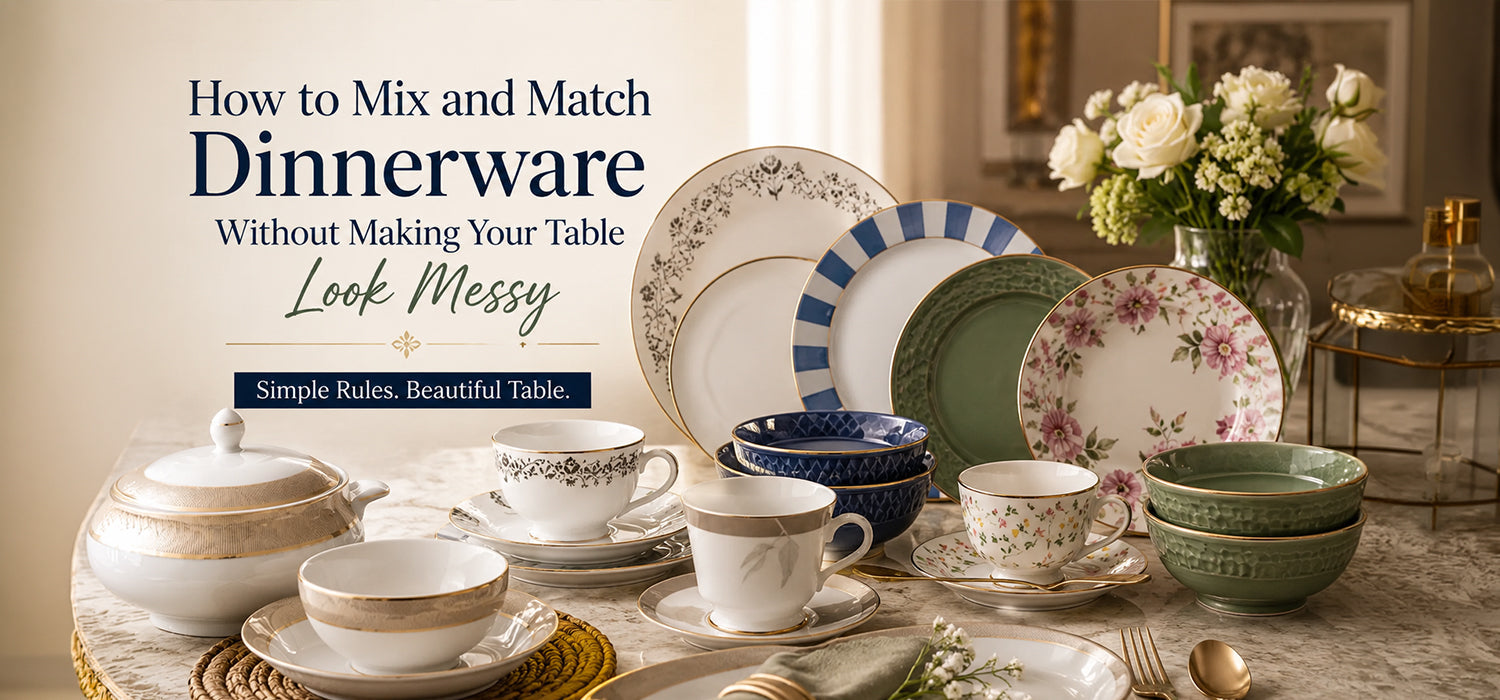
How to Mix and Match Dinnerware Without Making Your Table Look Messy
To mix and match dinnerware successfully, choose one visual element that remains consistent across the table. This may be a colour, material, border, shape or pattern style. Combine no more than two prominent patterns, repeat each design more than once, and use plain pieces between decorative ones. The finished table should feel connected rather than perfectly identical.
A fully matching dinner set creates an organised table, but it is not the only way to achieve elegance. Mixing complementary plates, bowls, serving dishes and tea cups can give your dining table greater personality and make existing pieces more useful.
The difficulty begins when every item introduces a different colour, metallic finish, pattern and shape. Instead of appearing thoughtfully collected, the table begins to look as though unrelated crockery was placed together because nothing else was available.
The solution is not to avoid variety. It is to control it. With a clear anchor colour, repeated shapes and a sensible ratio of plain to patterned pieces, you can build a layered table that feels distinctive without becoming untidy.
Key Takeaways
-
Choose one dominant colour or finish to connect different collections.
-
Use no more than two strong patterns in one table setting.
-
Repeat every contrasting design at least twice so it appears intentional.
-
Keep approximately half the visible tableware plain or lightly decorated.
-
Match the material and visual weight even when colours differ.
-
Use tea cups, saucers and serving pieces to introduce smaller amounts of contrast.
-
Leave enough open table space for food, glassware and comfortable dining.
What Does Mix-and-Match Dinnerware Mean?
Mix-and-match dinnerware is the deliberate combination of plates, bowls, cups, saucers and serving pieces that do not all come from one identical set.
The pieces may differ in:
-
Colour
-
Pattern
-
Shape
-
Border
-
Metallic finish
-
Collection
-
Size
-
Intended use
They should still share enough visual characteristics to appear related.
For example, a white porcelain dinner plate with gold lining can work with floral quarter plates when both pieces repeat the same gold detail. A blue dinner plate can be paired with a white bowl when the bowl provides visual relief and the blue appears elsewhere through napkins or a tea cup and saucer.
Mixing does not mean placing every favourite piece on the table at once. It means selecting differences that support one another.
Why Can Mixed Dinnerware Look Messy?
A mixed table usually looks disorganized when it contains too many competing focal points.
Common causes include:
-
Several unrelated colours
-
More than two dominant patterns
-
Gold and platinum detailing used without repetition
-
Different materials with noticeably different visual weights
-
Too many shapes
-
No plain pieces to create visual rest
-
Accessories that add further colours and patterns
-
Uneven distribution of designs across the table
One floral plate in an otherwise geometric setting may appear accidental. Three floral pieces distributed across the table establish a visible design decision.
Similarly, one gold-rimmed bowl surrounded by silver- or platinum-lined pieces may look misplaced. Repeating gold through selected saucers, napkin rings or serving bowls makes the combination feel intentional.
Azure Buying Insight
Before adding another pattern, ask what role it performs. A new piece should either repeat an existing colour, connect two different designs or provide a useful contrast. When it does none of these things, it usually adds clutter rather than character.
Start with One Anchor Element
The anchor is the piece or visual feature around which the entire table is built.
Your anchor may be:
-
A statement dinner plate
-
A floral serving bowl
-
A gold-lined dinner set
-
A blue-and-white pattern
-
A premium tea cup set
-
A particular metallic finish
-
A white porcelain base
-
A tablecloth or placemat colour
Once you choose the anchor, every additional piece should relate to it.
If the dinner plate contains blue, white and gold, you may repeat:
-
Blue through napkins
-
White through bowls
-
Gold through the cup-and-saucer border
You do not need to repeat every feature on every piece. One shared characteristic is often enough.
Use the 60–30–10 Dinnerware Rule
A practical way to control variation is to divide the visible tableware into three visual groups.
60% foundation pieces
These should be plain, neutral or lightly decorated.
Examples include:
-
White dinner plates
-
Neutral bowls
-
Clear glassware
-
Plain serving dishes
-
Simple table linen
30% supporting design
This is your main colour or pattern.
Examples include:
-
Blue quarter plates
-
Green katoris
-
Floral snack plates
-
Gold-bordered saucers
10% statement detail
Use the smallest proportion for the strongest element.
Examples include:
-
A patterned teapot
-
A decorative rice bowl
-
Metallic napkin rings
-
A floral centrepiece
-
A luxury cup and saucer set
The percentages do not need to be calculated exactly. Their purpose is to prevent every item from competing for attention.
Choose a Limited Colour Palette
Two main colours plus one neutral are enough for most mixed dinnerware tables.
Useful combinations include:
|
Main Colour |
Supporting Colour |
Neutral Base |
Overall Style |
|
Blue |
Golg |
White |
Refined and formal |
|
Green |
Beige |
Ivory |
Natural and relaxed |
|
Floral pink |
Sage |
White |
Soft and decorative |
|
Black |
Gold |
Cream |
Dramatic and modern |
|
Red |
Gold |
Warm white |
Festive and traditional |
|
Blue |
Platinum |
Pale grey |
Cool and contemporary |
Match the undertones
Warm colours such as cream, beige, red and gold usually work well together. Cooler colours such as white, grey, blue and platinum also create a natural connection.
Combining warm and cool tones is possible, but one should remain dominant. For example, white-and-blue plates can still work with gold lining when the gold is used as a small accent rather than the main colour.
Do not match colours too perfectly
Your blues do not need to be identical. A deep blue dinner plate can work with a softer blue tea cup set when both sit against white porcelain.
Slight variation creates depth. Large differences without a connecting neutral can make the table look fragmented.
How Many Patterns Can You Mix?
Use a maximum of two noticeable patterns in one place setting.
One pattern should be dominant and the second should be simpler or smaller in scale.
Good combinations include:
-
Large floral pattern with a narrow geometric border
-
Bold blue motif with a plain gold rim
-
Organic leaf design with subtle textured white porcelain
-
Fine stripes with small botanical details
-
Decorative dinner plates with plain cups and saucers
Avoid combining:
-
Large florals with another large floral design
-
Several unrelated geometric patterns
-
Strong traditional motifs with highly modern abstract artwork
-
Multiple metallic borders in different colours
-
Patterned plates, bowls, linen and glassware simultaneously
When both dinner and tea pieces are patterned, separate them visually with plain quarter plates, snack plates or serving bowls.
Repeat Shapes to Create Order
Shape can connect dinnerware even when colours differ.
Round dinner plates, round quarter plates and round saucers naturally feel related. Introducing one rectangular platter can create useful contrast, but using several unrelated silhouettes may make the table appear less organised.
Choose one dominant shape family:
-
Round and softly curved
-
Angular and geometric
-
Organic and irregular
-
Traditional and ornamental
A round cup and saucer can work with several dinnerware collections because its repeated circular form creates order. The colour or border then becomes the secondary connection.
Keep the Material Consistent
Dinnerware is easier to mix when the pieces have similar visual weight and surface finish.
Porcelain dinnerware generally coordinates well with other porcelain pieces because the surfaces, edges and levels of refinement feel related. The Azure Collection offers porcelain dinner sets alongside 12-piece cup-and-saucer sets and complete 17-piece tea services, providing several ways to build a coordinated material base.
You can still introduce another material through:
-
Clear glassware
-
Wooden serving boards
-
Metal cutlery
-
Linen napkins
-
A stone centrepiece
Avoid adding too many competing crockery materials within the same place setting. A heavy rustic bowl beside fine gold-lined porcelain may look disconnected unless the table is deliberately styled around that contrast.
Use Plain Pieces as Visual Breathing Space
Plain pieces are what make decorative dinnerware look intentional.
For example:
-
Patterned dinner plate + plain quarter plate + patterned katori
-
Plain dinner plate + floral quarter plate + plain bowl
-
Blue plate + white bowl + blue-and-white cup and saucer
-
Gold-rimmed plate + plain serving bowl + gold-rimmed saucer
A table containing only statement pieces has no clear focal point. Plain white or neutral crockery gives the eye somewhere to rest and helps stronger designs remain visible.
Explore premium porcelain dinner sets
How to Mix Dinnerware for Indian Meals
Indian meals often involve more individual and shared pieces than a minimal table setting. This makes functional planning particularly important.
A typical setting may include:
-
Dinner plate
-
Quarter plate
-
One or two katoris
-
Water glass
-
Cutlery
-
Serving bowls
-
Rice bowl
-
Bread basket or platter
-
Condiment bowls
Not every item should carry a prominent pattern.
Keep individual place settings balanced
Use the main pattern on one or two personal pieces. If the dinner plate is decorative, choose simpler katoris. If the dinner plate is plain, the quarter plate or bowl can introduce colour.
Let serving pieces connect the table
Shared bowls can repeat the pattern or colour used across individual place settings. One floral serving bowl in the centre can connect floral quarter plates positioned around the table.
Do not fill every available area
Open space is part of the design. Leave enough room to pass breads, curries and rice without moving decorative items.
How to Coordinate Dinnerware with a Tea Cup Set
Tea service gives you an easy way to extend a dining theme without making every piece identical.
A cup and saucer set is visually smaller than a dinner set, so it can introduce a stronger colour or pattern in a controlled way.
Match one detail, not the complete design
Your tea cups and saucers may repeat:
-
The gold lining of the dinner plates
-
The blue used in the serving bowls
-
A floral element from the quarter plates
-
The white porcelain base
-
The geometric style of the table setting
The tea service does not need to be an exact match.
Use matching collections for the safest combination
Matching design families can provide consistency while allowing different product formats.
Azure currently lists Floeur as both a dinner-set design and a 12-piece gold-lined tea service. The Floeur tea set includes six tea cups and six saucers, with floral accents and 22-carat gold lining.
Blue Mirage also appears across dinnerware and tea service. Its 12-piece tea cup and saucer composition contains six cups and six matching saucers in soft blue tones.
Balad is another design that appears in Azure’s dinner and tea ranges. The 12-piece Balad tea service includes six cups and six gold-finished saucers with 22-carat gold lining.
These coordinated families are suitable for buyers who want variation in function without introducing an unrelated design language.
Use contrast for a collected look
A floral dinner set can be paired with plain gold-rimmed cups. A minimal white dinner set can be combined with a blue or botanical luxury tea cup set.
The contrast should still repeat at least one colour, border or material.
Cup-and-Saucer Set or Complete Tea Set?
Choose according to how you serve tea.
Cup-and-saucer set
A 12-piece cup and saucer set commonly contains six cups and six saucers. It suits buyers who already own a teapot or prefer to prepare tea separately.
Azure’s Blue Mirage, Balad and Floeur 12-piece products follow this six-cup, six-saucer composition.
Complete tea set
A complete tea set may also include a teapot, milk pot and sugar pot.
The Golden Whisper 17-piece formal tea service contains six teacups, six saucers, a teapot with lid, a sugar pot with lid and a milk pot. It also carries 22-carat gold lining.
Some shoppers use the phrase tea kettle set when searching for this format. However, a coordinated porcelain service generally contains a teapot rather than an electric or stovetop kettle. Confirm the exact composition before purchasing.
Which format is easier to mix?
A cup-and-saucer set is easier to introduce as an accent because it contributes fewer visual elements.
A complete set creates a stronger focal point because the teapot, sugar pot and milk pot repeat the design. When using a complete formal tea service, keep snack plates, trays and linens relatively simple.
Five Reliable Mix-and-Match Formulas
Formula 1: White foundation with patterned accents
Use white dinner plates, patterned quarter plates, plain katoris and a patterned tea cup set.
Best for: First-time mixing and modern homes.
Formula 2: One collection in different product formats
Use a Floeur dinner set with selected pieces from the matching Floeur cup-and-saucer set.
Best for: Formal hosting and buyers who prefer a safe coordinated look.
Formula 3: Shared metallic border
Combine different white-based porcelain designs that all contain gold lining.
Best for: Weddings, Diwali and anniversary dining.
Formula 4: Tonal blue table
Use deep-blue dinner plates, lighter-blue cups and white bowls.
Best for: Contemporary dining rooms and afternoon tea.
Formula 5: Plain dinnerware with a statement tea service
Use minimal dinner plates and serving bowls with a decorative 17-piece tea set.
Best for: Tea-led gatherings where the teapot should remain the visual focus.
Product Recommendation Box
Recommended for:
Homeowners who want a coordinated table but do not want every plate, bowl and cup to be identical.
Why it fits:
The Azure Collection carries related designs across dinner sets, 12-piece cups-and-saucers and complete 17-piece tea services. Buyers can either select the same pattern in different product formats or combine a neutral dinner set with a stronger tea-service design.
Consider before buying:
Check the metallic finish, material, exact composition and care instructions. A matching product name does not automatically mean that every item has the same dimensions, border width or suitability for appliances.
Explore:
Compare premium tea sets and cup-and-saucer collections
Common Mix-and-Match Mistakes
Using too many unrelated colours
Three or four strong colours can work in professional styling, but most home tables look more organised with two main colours and one neutral.
Combining every pattern you own
A collection can be eclectic without displaying everything simultaneously. Select pieces that support the current meal and occasion.
Mixing gold and platinum without a plan
Both metallic finishes can coexist, but one should remain dominant. Repeat the secondary metal through only one or two accessories.
Forgetting to repeat the contrast
One different plate looks accidental. Repeat the contrasting design around the table.
Adding patterned linen beneath patterned crockery
When dinnerware already carries strong artwork, choose plain or lightly textured table linen.
Mixing formal and casual pieces unevenly
A single ornate cup beside heavily rustic crockery may appear out of place. Create balance by repeating the formal or casual style elsewhere.
Ignoring scale
Large patterns work better with small or subtle supporting designs. Two large patterns compete for attention.
Overloading the table with accessories
Napkin rings, candles, flowers, placemats and decorative trays should not all become focal points. Remove anything that restricts food service or conversation.
How to Build a Mix-and-Match Collection Over Time
You do not need to purchase an entirely new table setting at once.
Begin with:
-
Six versatile dinner plates
-
Six neutral bowls or katoris
-
Six quarter plates in one supporting design
-
Two or three serving bowls
-
One coordinated tea cup set
-
Clear or neutral glassware
Then add statement pieces gradually.
A premium tea cup set or luxury cup and saucer set can be a practical first addition because it creates a new hosting experience without requiring you to replace your current dinnerware.
When expanding the collection, keep a photograph of your existing pieces on your phone. Compare the base colour, border, shape and finish before ordering another set online.
How to Care for Mixed Dinnerware
Different pieces may require different care, even when they appear compatible on the table.
The Azure care guide recommends using lukewarm water, mild liquid soap and a soft sponge or cloth. It advises avoiding harsh detergents, bleach, steel scrubbers, wire brushes and abrasive pads that may scratch or affect decorative finishes.
Wash tea and coffee pieces soon after use to reduce the chance of staining. Dry every item completely, and place soft separators between stacked plates, bowls or saucers.
For metallic accents, printed artwork and premium finishes:
-
Clean gently by hand whenever possible.
-
Avoid prolonged soaking.
-
Do not use abrasive cleaning tools.
-
Protect pieces during stacking and storage.
-
Follow the exact product instructions for dishwasher and microwave suitability.
Do not assume all items in a mixed collection can be cleaned through the same method.
Explore Coordinated Tableware at The Azure Collection
The Azure Collection offers premium porcelain dinner sets, 12-piece tea cups and saucers, complete tea services and related tableware across white, blue, green, floral, gold-lined and platinum-lined designs. Its current tea-set category includes 13 products, while the cup-and-saucer category includes designs such as Blue Mirage, Balad, Blue Leaf, Floeur and Green Leaf.
For the safest mix, choose the same design family across dinner and tea service. For a more individual table, select one neutral collection and introduce contrast through a luxury tea cup set or decorative serving piece.
Before purchasing, compare:
-
Material
-
Main colours
-
Pattern scale
-
Gold or platinum lining
-
Piece composition
-
Care instructions
-
Current availability
-
Shipping and refund conditions
Azure’s shipping-policy page currently states free shipping within India, while the promotional header states free shipping above ₹9,999. Its refund policy allows replacement guidance for imperfect or damaged products but does not offer returns or exchanges for products delivered in perfect condition. Verify the applicable terms before placing an order.
Explore dinner sets, tea sets and cups and saucers
Frequently Asked Questions
How many dinnerware patterns can I mix on one table?
Two prominent patterns are usually enough for a balanced home table. Use one as the dominant design and the other as a smaller accent. Add plain or lightly decorated pieces between them so the table does not appear overcrowded.
Do tea cups and saucers need to match the dinner set?
No, tea cups and saucers do not need to match the dinner set exactly. They should repeat at least one element, such as the base colour, metallic border, material or pattern style. This creates connection while preserving a collected appearance.
Can I combine floral dinnerware with geometric pieces?
Yes, floral and geometric designs can work together when their colours are related and one pattern is visually quieter. Pair a large floral design with a narrow border or small geometric motif rather than another dominant pattern.
Is a premium tea cup set suitable for everyday use?
A premium tea cup set can be used regularly when its material and care instructions support daily use. Check whether metallic detailing or printed artwork requires hand washing, and confirm microwave and dishwasher suitability on the exact product page.
What is the difference between a cup-and-saucer set and a tea set?
A cup-and-saucer set usually contains only cups and their matching saucers. A complete tea set may also include a teapot, milk pot and sugar pot. Always review the stated composition because retailers may use tea-set terminology differently.
What should a tea kettle set include?
A product described informally as a tea kettle set may contain cups, saucers, a teapot, milk pot and sugar pot. Porcelain services normally include a teapot rather than a heating kettle, so verify the composition and do not place the pot on a stove unless the instructions expressly permit it.
How can I mix gold- and platinum-lined dinnerware?
Choose one metallic finish as the main element and use the second sparingly. For example, gold-lined dinner plates can be paired with plain white bowls and a subtle platinum-accented serving piece, provided both finishes are repeated deliberately and the rest of the table remains neutral.
Final Recommendation
To mix and match dinnerware without creating a messy table, build every setting around one anchor. Repeat its colour, shape, material or border across selected pieces, then use plain dinnerware to create visual breathing space.
Keep the palette limited, use no more than two strong patterns and ensure each contrasting design appears more than once. When adding a tea set, choose either a matching design family for consistency or a complementary luxury cup and saucer set for controlled contrast.
The objective is not perfect matching. It is visible connection. Every plate, bowl, tea cup and saucer should look as though it was chosen for the same table, even when it comes from a different collection.
Explore The Azure Collection’s dinnerware and tea-service ranges to build a table that feels layered, personal and thoughtfully coordinated.
Written by Amit Sharma
Read more
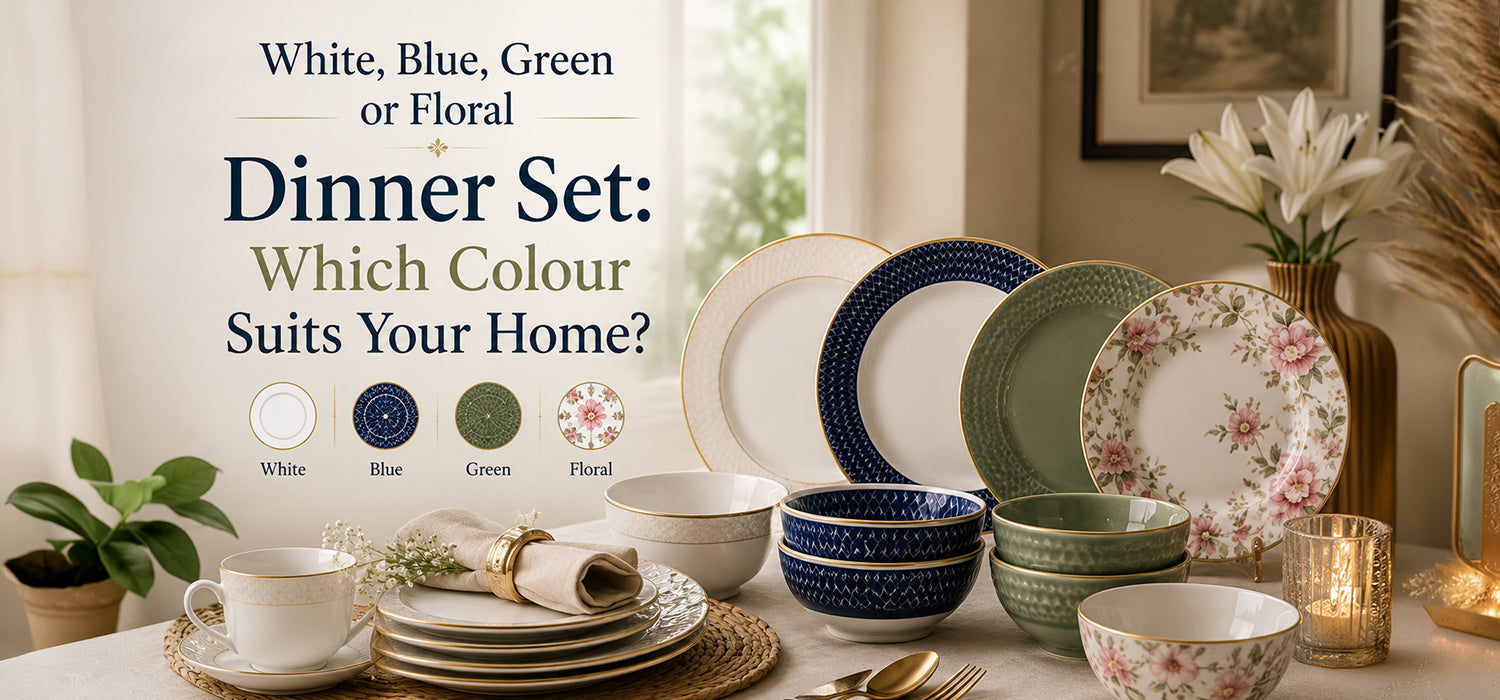
White, Blue, Green or Floral Dinner Set: Which Colour Suits Your Home?
The right Dinner Set Design should complement your dining room without disappearing into it or competing with everything around it. White suits classic, minimalist and frequently changing interiors...
Read more
Complete Tableware Checklist for a New Home
A complete Tableware Set for New Home should begin with six dinner plates, six side plates, six to twelve katoris, six glasses, cutlery and two or three serving bowls. Add one platter, mugs or cups...
Read more


